


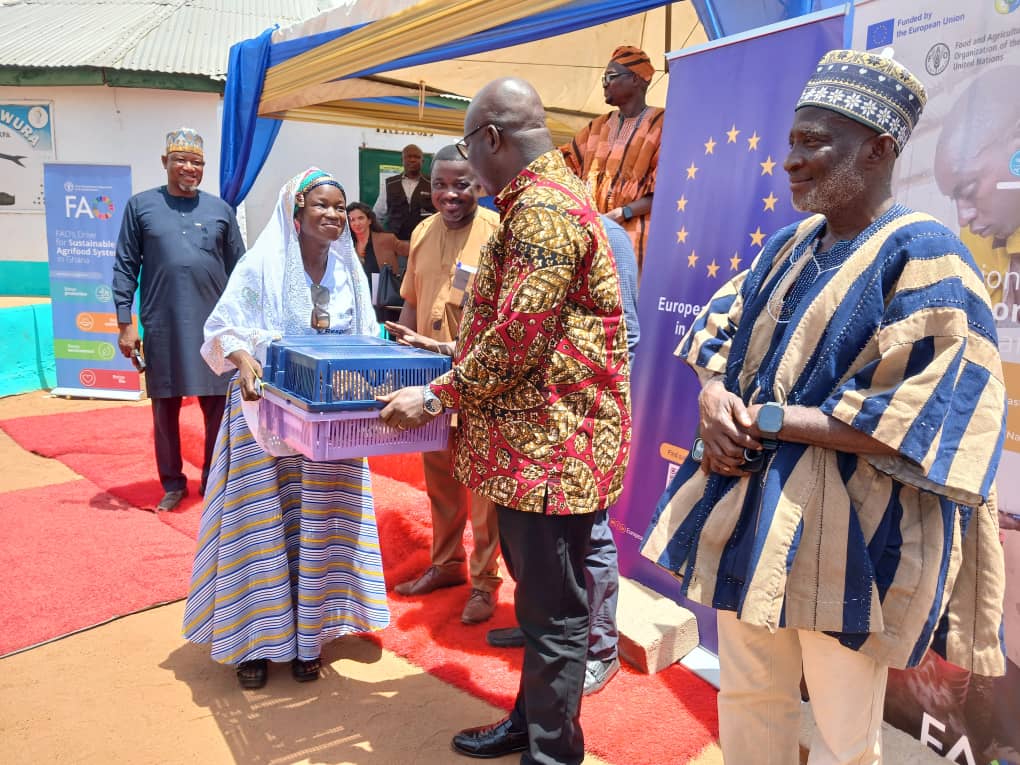
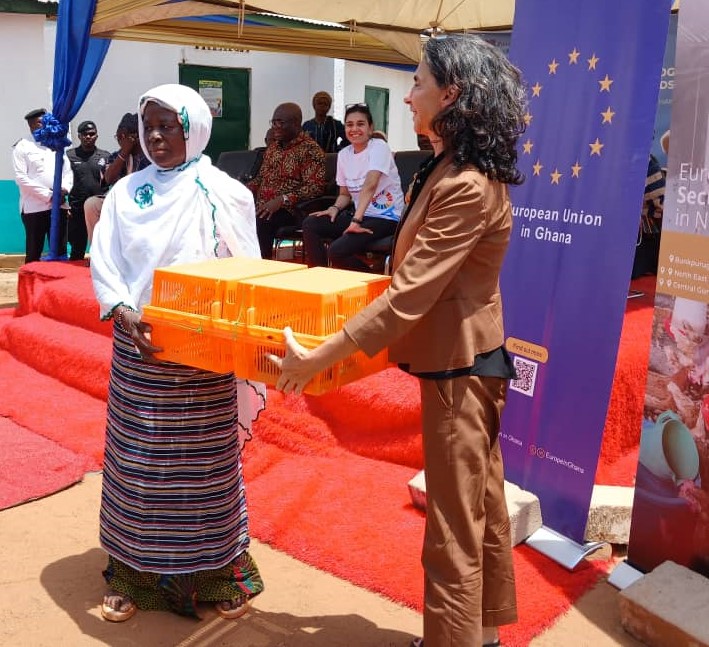
The European Union (EU) has reinforced Ghana’s drive to boost local poultry production under the Feed Ghana Programme with the donation of 150,000 fully vaccinated birds to farmers in Northern Ghana.
The support was announced during the launch of the government’s Nkoko Nkitinkiti initiative at Gbung in the North East Gonja District of the Savannah Region.
The intervention, delivered through the EU-funded Food Security Response Northern Ghana Project in partnership with the Food and Agriculture Organization (FAO) and the Ministry of Food and Agriculture (MoFA), is expected to benefit about 3,000 farmers across six districts in the Savannah, Upper East, and Northeast regions.
Beyond the poultry birds, beneficiaries have also received feed, essential veterinary medicines, and technical training in poultry management and agribusiness to enhance productivity and ensure sustainability.
Overall, the initiative is projected to impact some 15,000 rural households by strengthening food and nutrition security, boosting incomes, and generating employment along the poultry value chain.
Speaking at the event, the EU Ambassador to Ghana, H.E. Rune Skinnebach, described agriculture and food security as a key pillar of EU-Ghana cooperation. He noted that the intervention would help reduce Ghana’s reliance on imported poultry while boosting local production and employment.
Ghana currently imports poultry products valued between 300 and 400 million US dollars annually. Government, through the Feed Ghana Programme, is targeting self-sufficiency in poultry production within the next three years.
Minister for Food and Agriculture, Dr. Eric Opoku, said the initiative aligns with government’s broader strategy to reduce import costs and make poultry products more affordable to Ghanaians. He added that increased local production would also provide sustainable income opportunities, particularly for rural households.
Dr. Opoku further outlined complementary government interventions aimed at supporting farmers. He revealed that GHS300 million has been allocated to the National Food Buffer Stock Company to purchase excess produce from farmers, addressing market access challenges. He acknowledged, however, that limited storage capacity remains a challenge, with government engaging private warehouse owners to expand storage options.
He described the initiative as a significant step toward building national food reserves for emergencies, noting that it marks a new direction in Ghana’s agricultural policy.
The Minister also announced plans to establish five maize processing centers in key producing districts to add value to maize, support exports, and ensure stable markets for farmers. Additionally, he disclosed that fertilizers will once again be distributed free of charge to farmers this year to cushion them against falling commodity prices, with distribution to be monitored at the district level to ensure transparency.
The FAO Representative to Ghana, Ms. Priya Gujadhur, emphasized that the project goes beyond the distribution of inputs by equipping farmers with practical skills in poultry management and agribusiness. She noted that supporting local egg and poultry production is key to promoting sustainability and strengthening rural livelihoods.
As part of the broader intervention, farmers will also benefit from hatchery support and continuous training to scale up production.
Launched in September 2023 with a funding envelope of 10 million euros, the EU Food Security Response Northern Ghana Project is supporting over 50,000 smallholder farmers affected by global shocks, including the Russia-Ukraine conflict and climate variability.
Since its inception, the project has recorded significant gains. More than 12,000 farmers have adopted improved farming technologies, resulting in increased yields. Nearly 500 farmers have been trained in climate-resilient seed production, leading to the establishment of 11 seed farms and the production of about 20 metric tonnes of certified seeds.
Post-harvest management has also improved for over 10,000 farmers through the provision of storage bags, threshers, and moisture testers, helping to reduce losses and increase incomes. Additionally, 4,000 women have been supported through Village Savings and Loans Associations, improving financial inclusion and access to credit.
Livestock interventions under the project include the training of veterinary technicians, vaccination of over 7,000 small ruminants, and protection of more than 168,000 poultry birds against diseases.
A feasibility study has also been completed for 44 solar-powered irrigation sites expected to benefit over 12,000 farmers, with construction set to begin in July 2026.
The EU and its partners say the intervention highlights their continued commitment to strengthening resilient food systems and supporting Ghana’s long-term agricultural transformation agenda.
Source: Ibrahim Angaangmeni Alhassan/zaaradio.com
